




Hire
Amit.

Jack of all trades, master of one.

Polaroid of Amit at a whiteboard, drawing a chart for a room of people

Fifteen years inside consumer businesses, in service of building one skill: finding the underlying issue. A recent call took one brand from losing money to $30M at 10% margins. Now I advise. Here's the pitch deck.

Scroll
Where you are

You've got big problems.

The good news is that I like big, messy, expensive problems. Big problems usually sit on top of big opportunities. You hired the right team, built something people love, and ran efficient marketing — and the charts still didn't move up and to the right.

A cassette tape labeled by hand: Big Problems
Where you are

It's never just one problem.

Root cause analysis (RCA) assumes there’s one root cause. I have never found one. It is usually multiple issues tangled into one giant ball that presents as a single problem.

The same cassette's tape, pulled out and tangled into a single knotted mess
What the room is looking at
CAC is up again this quarter
Month-one retention is soft
Carts are small and single-item
Retail is stalled, online is flat
What's actually going on
Four symptoms. One constraint underneath, causing all of them.
Fix the four and you buy a quarter. Fix the one and the four stop happening.
Where you are

Send me your problems.

You know something feels off, maybe you’ve counted some symptoms, but no one can tell you what’s happening. Call me — just like these people did:

How it works

I ask the right questions.

I find the question nobody's asked yet. Usually it's one step underneath whatever the room is arguing about — and once it's on the table, the real constraint shows itself.

Figure to comeOne index card, one question in handwriting, the word that matters underlined in red.
How it works

We solve problems with data.

The first two steps take the longest. Once you know what’s actually broken, the test is usually cheap and fast.

Figure to comeThe D·A·T·A loop as an actual loop: four stations on a circuit, a marker travelling round it, the fourth feeding the first.
Then it starts over. Your team runs it the second time, and better than the first.
How it works

What I hold to.

Five things I try to hold to. They don’t change when an engagement is going badly.

  1. 01Choose to be curiousStay hungry to understand how things work.
  2. 02Create my own pathMove toward success I chose myself, not success handed to me.
  3. 03Stay optimisticTrust that tomorrow can be better, and work to make it true.
  4. 04Accept realityStop fighting the shape of reality, and find peace instead.
  5. 05Have empathyPut myself in others' shoes, and assume positive intent.
How it works

A simple way to work together.

You don't pay me for my time. You pay me to solve the problem. Execution is the cheap part — agencies, freelancers and your own team can do it.

Figure to comeThe engagement as a ruler: weekly marks, a written set of hypotheses after each, an end mark that is a choice, not a cliff.
Thirty days, money back. If the first month doesn't earn its keep, you don't pay for it. The fee follows the size of the problem, not the hours.
How it works

What I'll do. What I won't.

I don’t have an agency behind me, so I don’t make money on what I recommend. That’s the only real reason to trust the right-hand column.

Figure to comeThe two columns as two ink stamps: WILL in green, WON’T in red, the impression slightly uneven.
What I'll do
Find the constraint before you spend on it
Put a number on every claim, mine included
Leave a written test plan behind each week
Say the unpopular thing while it still helps
·
What I won't
Run your standups
Take guesses
Sell you software you don't need
Work on what anyone else can
If the answer is that you need a retention person, a better CFO, or nobody at all, I will tell you that too.
How it works

Who I work best with.

I’m not a turnaround guy. This works best when the business already works: real customers, a team you trust, and growth that stopped for a reason nobody inside can name.

An 80s employee time punch card, five rows punched, the sixth left blank
  • You've hit product-market fit
  • Your market is big enough to matter
  • You're doing $10–20M+ in ARR
  • You're already profitable
  • You've built a team of 10+ A players
  • Not sure? Let's talk anyway
You don't need to check every box. Send me a note and we'll talk it through.
Amit Shah
Amit. Builds furniture out of plywood.

Write me a note.

Tell me what needs work. Short is fine — "something's off and I can't name it" is a complete message.

Problems I've solved

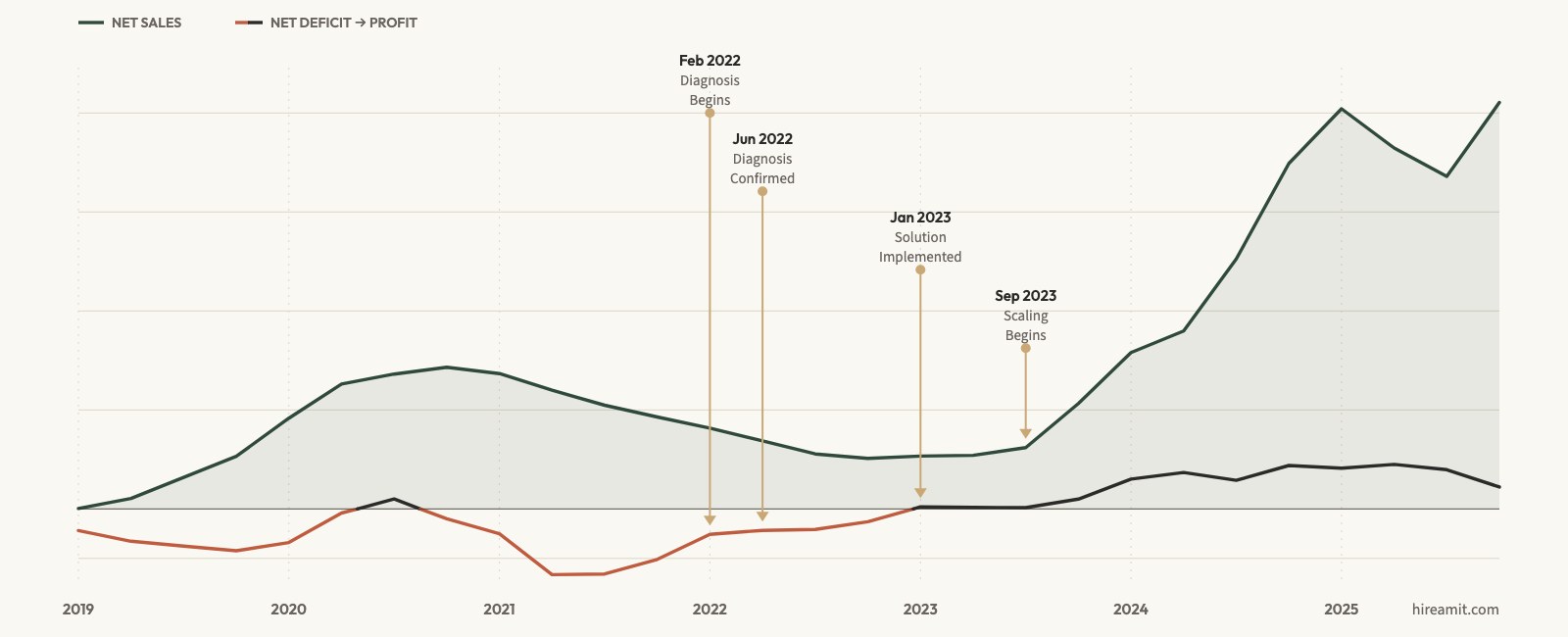
Everyone said growth was the solution. Wrong.

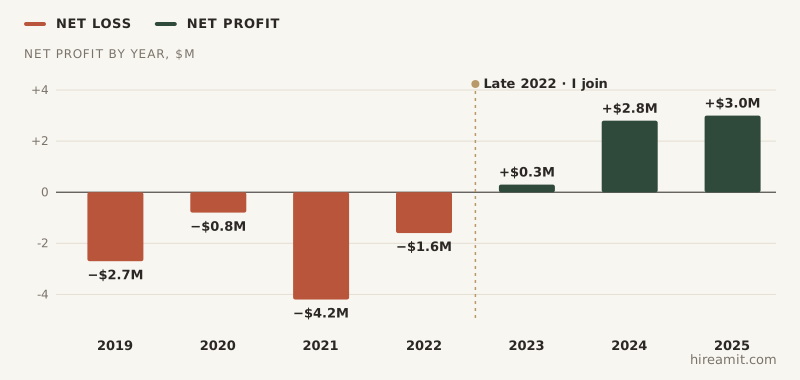
Seven years of net sales. I joined at the dashed line. Everything left of it happened while the company was spending hard on growth.

Hypothesis
The numbers said the business model was wrong at any size. Fix that first, before spending another dollar on growth.
Test
Rebuild the unit economics on the existing volume, and hold the margin at every step up.
Verdict
Profitable at $5.5M, before the growth. $30M net sales in 2025 at 10% net margin, held while scaling.
AMIT JOINS, LATE 2022 $1.9M2019 $9.9M2020 $9.1M2021 $5.1M2022 $5.5M2023 $19M2024 $30M2025
Net salesLossProfit
Problems I've solved

Four problems, four verdicts.

Anonymized at the clients' request. Every one runs the same three beats: what I believed was true, the cut of data that would settle it, and the number it came back with — including when it went against me.

Figure to comeFour folder spines on a shelf edge, each labelled Hypothesis / Test / Verdict.
Same method every time: hypothesis, test, verdict. The write-up goes to your team, so the next one they can run without me.
Problems I've solved · Supplements & wellness

Four straight years of losses. Growth was making it worse.

Revenue had run to $9.9M and fallen back to $5.1M, losing money the whole way. The brand had already proved it could grow. Growth was the thing hurting it.

Hypothesis
The economics are broken at any size, so scaling only multiplies the direction they already point.
Test
Fix the unit economics first, at low volume, and refuse to spend on growth until a year closes profitable.
Verdict
First profitable year at $5.5M, before any growth. Then $18.8M, then $30M at roughly 10% net — profitable the whole way up.
Data figure to comeContribution margin per order, before and after: two bars, the second one above the line.
The order is the lesson. Growth multiplies your economics, whichever way they point.
Problems I've solved · Sustainable apparel

The bundle builder felt obvious. The data said skip it.

Average order value is the lever everyone agrees on, and a bundle builder is the prom king of AOV tactics. We believed it too.

Hypothesis
Where you ask matters more than what you ask.
Test
Run the bundle builder against a one-click post-purchase offer, same products, same discount.
Verdict
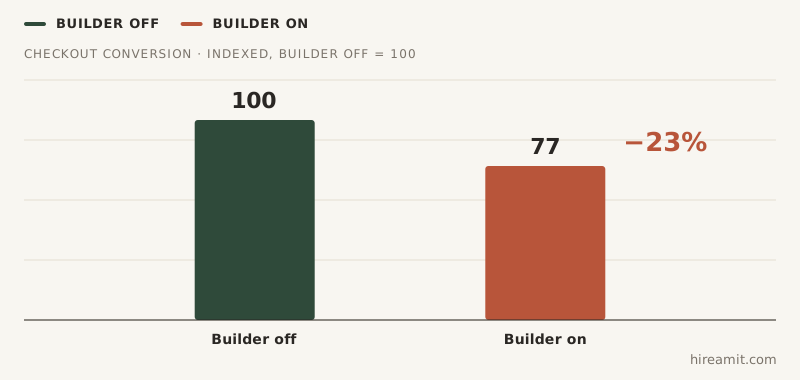
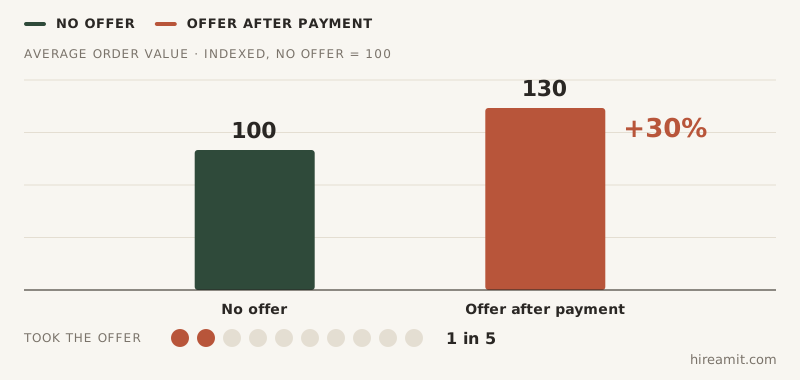
The builder dropped conversion 23%. The post-purchase offer lifted AOV 30% at a 20% take rate.
Data figure to comeConversion rate with the bundle builder on versus off, and AOV with the post-purchase offer: the trade the data showed.
Protect the first yes. Then sell the second yes, after the money is already in.
Problems I've solved · Premium menswear

A return isn't a failure. It's a customer still leaning in.

In-store reps loaded first orders past three items, so some of it naturally came back. The instinct in the room was to drive the return rate down.

Hypothesis
Returners aren't churning. They're fit-seeking, which is what committing looks like.
Test
Cut lifetime value by return cohort instead of counting the cost per return.
Verdict
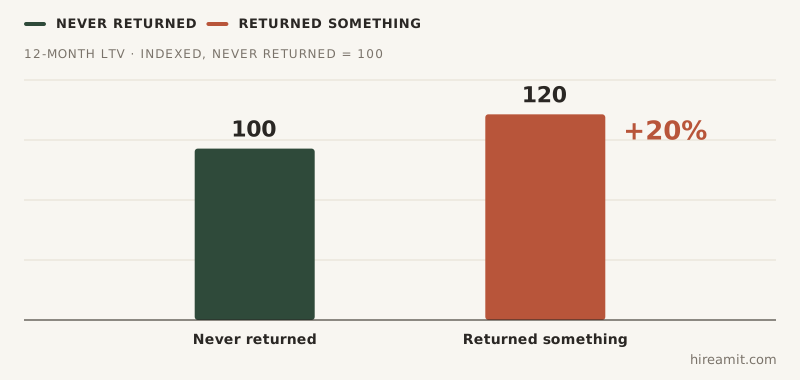
Customers who returned something carried 20% higher LTV than customers who never returned anything.
Data figure to comeTwelve-month LTV, returners against never-returners, the returners ahead.
The question isn't what a return costs. It's what the customer who makes one is worth.
Problems I've solved · Checkout economics

We turned on Apple Pay. First-order AOV went down.

Every CRO checklist puts express wallets near the top, and none of it is wrong about friction. We turned it on expecting a clean win.

Hypothesis
The faster path is skipping something worth more than the friction it removes.
Test
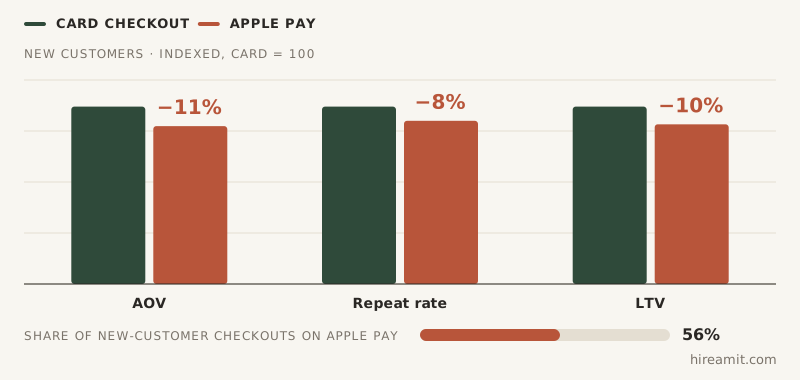
Split AOV, repeat rate and LTV by payment method on a clean cohort.
Verdict
Apple Pay reached 56% of new checkouts at 11% lower AOV, 8% lower repeat rate and 10% lower LTV. We turned it off.
Data figure to comeFirst-order AOV and twelve-month LTV, Apple Pay on versus off.
Shopify doesn't render the post-purchase offer for wallet orders. Price the tradeoff before you enable one.